Stand on the patio at Durty Bull on a Tuesday night in September and you'll hear it before you see it: a swell of applause rolling over the outfield wall, then the PA announcer's voice bouncing off the brick face of a 127-year-old cotton mill turned apartment building next door. That mill is now home to people who signed leases without ever having lived next to a professional baseball stadium before, because until five years ago, nobody in Gastonia had that option.
Here's the part that's easy to miss if you just drive past the FUSE District on your way somewhere else: it didn't fill in the way most neighborhoods do. Usually the houses show up first, then a coffee shop tests the market, then a brewery decides the rooftops can support a full liquor license. Gastonia ran that sequence in reverse. The ballpark came first. Everything else, including the housing, got built to face it.
The Order Things Opened Tells You Something
CaroMont Health Park opened in 2021 on land that used to hold a Sears store, a parking lot, and the Budget Inn, all torn down after the city bought the parcels to assemble what's now called the FUSE District. For the first few years, the stadium sat mostly alone out there, a single draw surrounded by empty lots and one very old brick mill.
Then, in the summer of 2024, Durty Bull Brewing Company opened a taproom at 126 S. Trenton Street, close enough that its patio looks straight into right field. The Durham-based brewery built 5,000 square feet indoors and another 5,000 outdoors, a bet that people would want a beer within walking distance of a game they'd just watched.
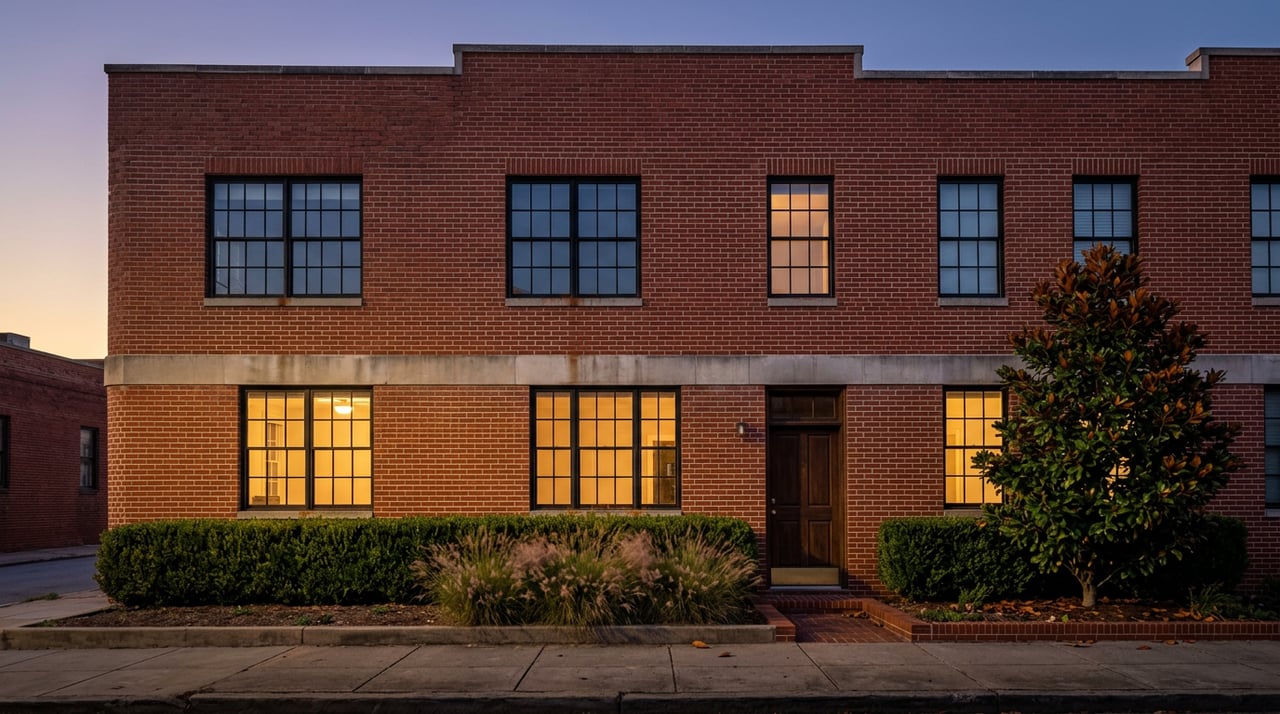
Around the same time, the mill next door started taking tenants. The building at 612 W. Main Ave. is the oldest standing textile mill in Gastonia, a cotton mill that ran without interruption from 1893 to 1972 before sitting vacant for decades. Lansing Melbourne Group put $24.3 million into converting it into 85 loft apartments, working with the National Park Service to keep the original brick intact. At the groundbreaking, the company's Peter Flotz said the plan was to "protect and enhance" a building that had already stood for over a century. Those units are leasing now, with studios listed as low as $1,065 a month and one-bedrooms running closer to $1,350.
That's three very different kinds of businesses, in that specific order: stadium, bar, housing. Most downtowns build it the other way around.
Why the Bar Is Closed on Mondays
If you've tried to swing by Durty Bull on a Monday and found it dark, that's not an oversight. The taproom runs Tuesday through Friday from 4 to 10 p.m., stretches to noon on Saturday, and closes early on Sunday at 8 p.m. Monday is the one day it doesn't open at all, which happens to line up with the Atlantic League's standard day off. The bar's calendar isn't independent of the ballpark's. It's downstream of it.
That matters if you live in the district and plan your week around what's open. A slow Tuesday game means a quiet patio. A Saturday doubleheader or a holiday game means the outdoor tables fill up fast. The FUSE District doesn't really have its own rhythm yet. It borrows the Ghost Peppers'.
The Team Upstairs Is Better Than the Address Suggests
Speaking of that schedule: the Gastonia Ghost Peppers aren't a placeholder tenant killing time between innings. Between 2021 and 2025, the club went 372-258, a 59.1 percent win rate. Narrow that window to 2022 through 2024 and the number climbs to 65.1 percent, a stretch the Atlantic League itself recognized as a record for that three-year span. Four straight playoff appearances followed, and 2026 opened with the Peppers chasing a fifth.
The home schedule gives residents real anchor dates. The team opens 2026 on the road at High Point on April 21, then hosts its first home game at CaroMont Health Park on April 24. For the second year running, they'll play a home game on July 4th against the Charleston Dirty Birds, which means Independence Day in the FUSE District comes with fireworks built into the ticket price, not just the calendar.
None of this requires you to be a baseball fan to matter. It means the busiest, loudest nights in the district are predictable months in advance, which is more than you can say for most neighborhood hot spots.
What Fills the Last Empty Lot
The district isn't finished catching up to its own stadium. Franklin Yards, a mixed-use project directly across the street from CaroMont Health Park, is adding 220 more apartments and commercial space, which will roughly triple the residential count the mill alone created. Waterbean Coffee, a chain that started in Cornelius and has grown to 14 locations across North Carolina, has plans for an 8,000 square foot shop and distribution center downtown, though no opening date has been set yet.
Add those to what's already running and you get a district built entirely around foot traffic that didn't exist before 2021: a ballpark, a brewery that faces it, a converted mill full of new neighbors, and two more projects in the pipeline. The FUSE District, connected to downtown by West Franklin Boulevard and the York and Chester Street corridor, was designed with sidewalks and bike lanes wide enough for the crowd it expected, before it had much of a crowd to plan for.
That's the part worth sitting with if you already live nearby. The usual complaint about new development is that the amenities never keep pace with the rooftops. Here it ran the other direction: the crowd showed up for baseball first, and the neighborhood is still being built to hold onto them after the last out.
Next time there's a home game, walk over early. Grab a table at Durty Bull before the outfield seats fill in, and take a look at the brick on the mill across the street. It's been standing since before night baseball was a concept anyone had. It's not going anywhere now either.
If you're weighing what a neighborhood like this means for a move, a sale, or just understanding what your corner of Gastonia is worth these days, Sierra Garren Group knows the FUSE District and the rest of the Gastonia market from the ground up. Let's Connect.